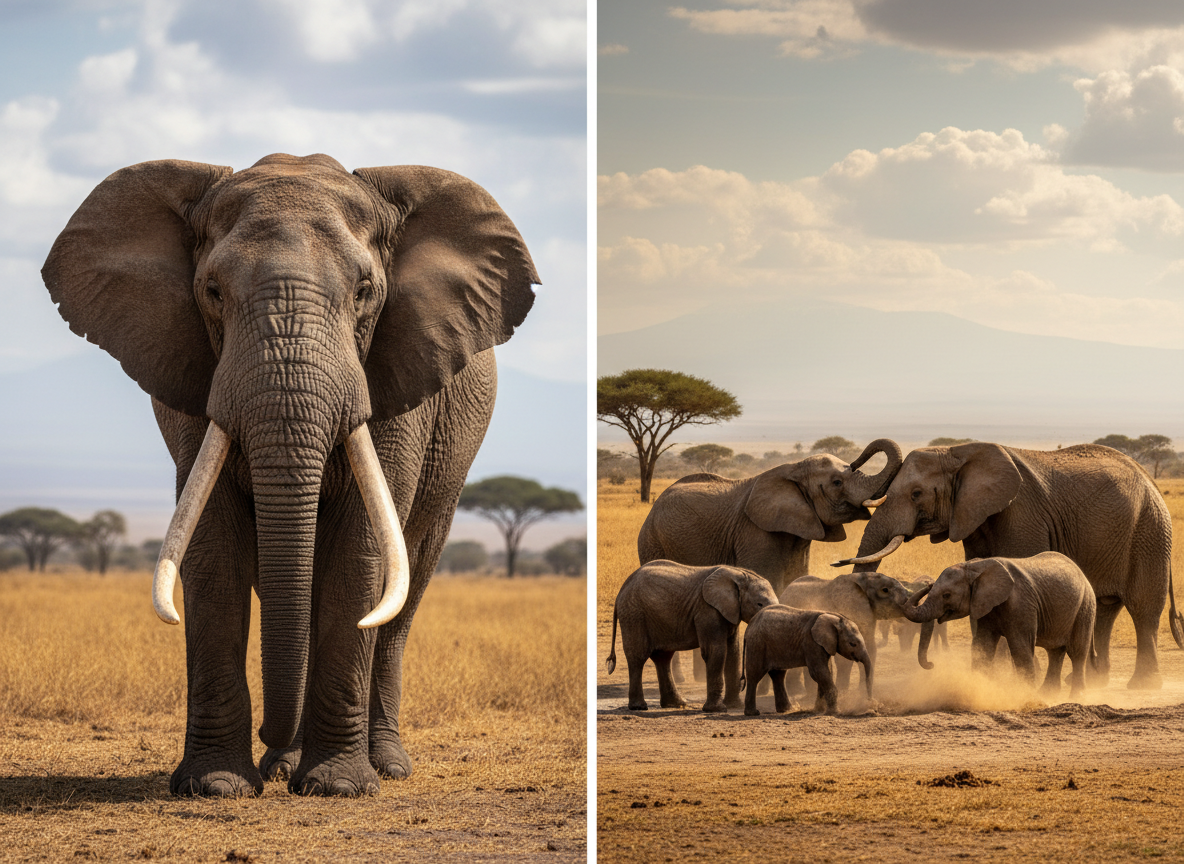
A super-tusker is not simply a large elephant. It is an animal that has survived long enough, and been genetically fortunate enough, to carry tusks of extraordinary size – ivory that in the most celebrated individuals sweeps downward past the knees toward the ground and weighs more than 45 kilograms on each side. Total tusk weight exceeding 90 kilograms. In practical terms, ivory that would have made these animals targets for ivory hunters at every point in the twentieth century.
The fact that any survive at all is remarkable. The fact that Amboseli holds the highest concentration of them in Kenya – possibly in all of East Africa – is the result of decades of protection and research in a specific ecosystem that has allowed individual bulls to reach the extreme old age at which tusks grow to these dimensions.
What Defines a Super-Tusker
The term super-tusker is not a formal scientific classification. It is a descriptive term applied to bull elephants – males only, as female African elephants carry much smaller tusks on average – with tusks that meet a threshold of extraordinary size and weight. Researchers and conservationists typically define the threshold as tusks weighing at least 45 kilograms per side, with total combined tusk weight of 90 kilograms or more. A “big tusker” sits just below that line: an elephant with genuinely exceptional ivory, sometimes with one tusk noticeably heavier than the other, that has not quite crossed the 45-kilogram-per-side threshold. Every super tusker was once tracked as a promising big tusker first, which is why conservationists monitor both categories rather than waiting until an individual officially qualifies.
For context: the average tusk weight in a mature Amboseli bull is around 10 to 20 kilograms per side. A super-tusker’s ivory is four to eight times heavier than the norm. The length is correspondingly dramatic: tusks that begin at the gum line and may extend two metres or more beyond the lip, curving downward and sometimes inward at the tips.
The genetic basis for super-tusker tusk growth is not fully understood. It is clear that certain family lineages produce large-tusked individuals more consistently than others, suggesting a heritable component. But tusk size is also a function of age – tusks grow continuously throughout an elephant’s life – so super-tuskers by definition are also very old animals, typically over fifty years. In a continental population that was devastated by ivory hunting and poaching across the twentieth century, few elephants have been allowed to reach that age.
Why Amboseli Has Them
Amboseli’s super-tusker population is not accidental. It is the result of three intersecting factors.
Continuous research and monitoring: The Amboseli Elephant Research Project, begun by Cynthia Moss in 1972, has documented the park’s elephant population continuously for over fifty years. Every elephant family is known, every individual is identified, and the history of the population – births, deaths, movements, family relationships – is recorded in more detail than almost any other elephant population on earth. This research culture has also created a social environment in which the elephants are deeply habituated to vehicles and researchers, allowing the kind of close observation that reveals which bulls carry exceptional tusks.
Effective anti-poaching protection: The Amboseli area – the national park itself and the surrounding Maasai community lands that the elephants use extensively – has been managed for conservation for decades. The protection has not been perfect: poaching incidents have occurred, particularly during the ivory demand surges of the 1970s-80s and 2000s-2010s. But the core population has been continuously monitored and defended in a way that has allowed individual bulls to reach extreme old age.
A particular ecosystem: The Amboseli ecosystem – centred on the swamp systems fed by underground water from Kilimanjaro – provides year-round water and grass for a resident elephant population of around 1,500 animals. That ecosystem stability means bulls do not need to range as widely as elephants in drier habitats, keeping them within the protected zone for more of their lives.
The Named Individuals: Tim, Craig, Tolstoy
The most famous super-tuskers of Amboseli are known by name – testament to the research culture that has made individual identification a foundation of the park’s management.
Tim is probably the most famous elephant in Kenya’s modern history. He was well over fifty years old and carried tusks that swept to within inches of the ground. A gentle giant by Amboseli standards – unusually tolerant of vehicles – Tim died of natural causes in February 2020. His death was widely mourned and extensively covered in conservation media. His tusks were preserved and remain the most famous example of what super-tusker ivory looks like in physical terms.
Craig was named for one of the longest-serving Amboseli researchers. He was a large, notably calm bull who for many years was one of the most reliably seen of Amboseli’s large-tusked males. Like Tim, Craig exemplified the combination of massive ivory and deep calm that characterises the park’s most studied bulls.
Tolstoy – named for the size of his bearing – was another of the named Amboseli super-tuskers, a massive bull with tusks of exceptional length. These named individuals became reference points for photographers and wildlife travellers visiting the park specifically to see super-tuskers.
The post-Tim generation of Amboseli’s large-tusked bulls includes several younger males with the genetic inheritance and the years ahead of them to potentially reach super-tusker dimensions, though confirming which individuals are on that trajectory requires time and continued monitoring.
How to Find Them in Amboseli
Super-tuskers in Amboseli are not found by luck alone. They are found by knowing where to look and when.
The swamp areas are the best consistent search area. Amboseli’s swamps – fed by underground water from Kilimanjaro’s snowmelt – are the ecological heart of the park and the place where elephant families and solitary bulls concentrate most reliably. The large bulls that carry exceptional tusks tend to be solitary or in loose association with other males, spending time at the swamp margins, in the acacia woodland, and on the open plains between.
Dawn and late afternoon are the best times. Large bulls feed actively in the cool hours and are often on the move between the swamp and the open plains in these windows. Midday finds most large mammals resting.
The research network is the most reliable tool. Guides who are plugged into the Amboseli Elephant Research Project’s monitoring, or who maintain communication with other guides in the park, know which specific bulls have been seen in which areas in recent days. A guide who knows that a large-tusked bull was near the Enkiama swamp yesterday morning will position you appropriately for a dawn drive today.
No sighting is guaranteed. Super-tuskers are not daily certainties even in Amboseli. But the combination of a knowledgeable guide, the right timing, and a few days in the park tilts the odds substantially toward a genuine encounter.
Conservation Context
The world’s population of super-tuskers is critically small. Estimates place the total number of living super-tuskers in Africa – elephants with tusks exceeding 45 kilograms per side – at fewer than thirty individuals. Kenya holds a significant proportion of them, with Amboseli as the most important single location.
The pressure on these animals from ivory poaching has never fully disappeared. Organised ivory trafficking syndicates track large-tusked individuals specifically; the ivory on a single super-tusker represents significant commercial value on black markets. Continued protection is not guaranteed; it is actively maintained at considerable cost and risk by the Amboseli ecosystem’s rangers, researchers, and community partners.
For visitors, an encounter with a super-tusker in Amboseli is not just a wildlife sighting. It is contact with one of the rarest and most biologically significant animals left on the planet – the living result of fifty years of conservation work in a specific ecosystem.
Every trip described here can be tailored: dates, budget, camps, and pace built around you.
Get a Personalised SafariFurther reading
More safari planning resources
- Map of Amboseli from Valley Safaris
- Amboseli destination guide on FindMySafari
- Big Five safari collection on FindMySafari
- Family safari collection on FindMySafari